Korea Halves EV Acquisition Tax Break to 700,000 Won
What changed
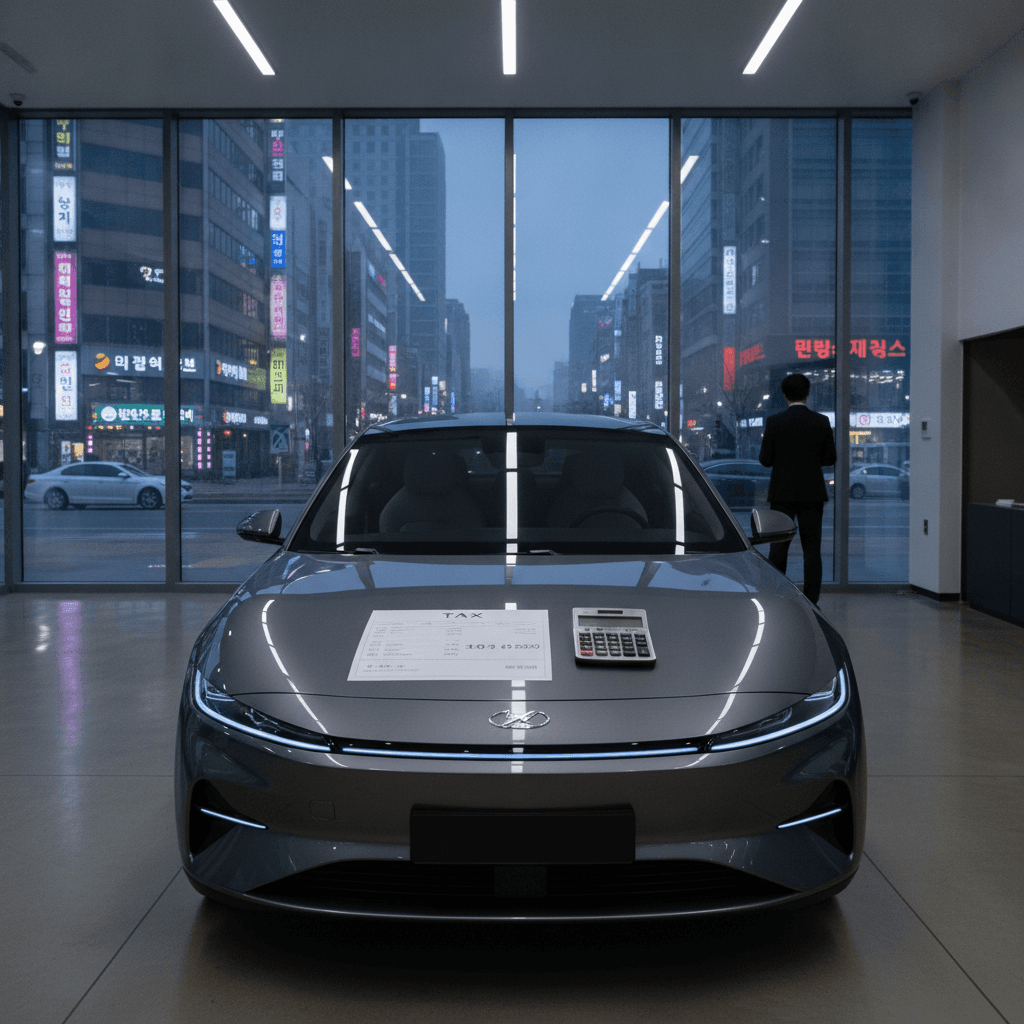
South Korea's Ministry of the Interior and Safety plans to overhaul an EV tax break that was set to expire at the end of this year. The good news for buyers: the program survives and is extended through end-2029. The bad news: the maximum relief drops from 1.4 million won to 700,000 won (roughly $1,000 to $500) — a 50% cut.
To understand who this hits, you need to know that Korea's acquisition tax break is a capped deduction, not a blanket exemption. Buyers pay a one-time acquisition tax when registering a vehicle, and the government waives that tax only up to a ceiling. So a car whose acquisition tax lands under 700,000 won still effectively pays nothing next year. Anything above that ceiling now comes out of the buyer's pocket.
Who actually pays more
Korea's passenger-car acquisition tax rate is generally 7%. Run the math and a 700,000 won tax bill corresponds to a taxable base of roughly 10 million won, while 1.4 million won corresponds to about 20 million won. In practical terms, buyers of mid- to high-priced EVs absorb the entire change. Because the taxable base excludes VAT, the sticker prices affected sit somewhat higher than those raw figures suggest.
For someone buying a microcar-class EV or a budget model, the difference may be close to zero. But the compact-and-larger EV SUVs and sedans that actually drive Korean volume comfortably exceed the new ceiling. So the effective outcome is a flat 700,000 won increase for most mainstream EV buyers. On a premium imported EV that's rounding error; on a 40–60 million won family EV, it's a real line item.
Why now — the wider context
The ministry's stated reasoning is straightforward: EV adoption has advanced far enough that the original justification for generous subsidies has weakened. Support designed to seed a nascent market is being tapered as that market matures.
This is not a uniquely Korean move. Governments across major auto markets have followed the same arc — aggressive purchase incentives early, then a staged withdrawal once volumes stabilize. What makes Korea's version notable is the layering. A Korean EV buyer typically stacks national purchase subsidies, local-government subsidies, an individual consumption tax reduction, and this acquisition tax break. National subsidy amounts have already been trending downward year over year. Halve the acquisition tax cap on top of that, and no single cut looks dramatic while the cumulative erosion of support becomes meaningful.
The timing is awkward for another reason. Korea's EV market has been working through a demand plateau — locally discussed as the "chasm" between early adopters and the mass market — and domestic EV sales growth has been uneven. Trimming incentives while demand is still stabilizing invites criticism that policy is working against recovery. The counterargument is that letting the program lapse entirely, as originally scheduled, would have been a far sharper shock. The three-year extension looks like the compromise between those two positions.
What it means for buyers
Purchase timing becomes the most immediate practical concern. If the change takes effect next year, there is up to a 700,000 won gap between a car registered this year and the same car registered next year. Korean acquisition tax is assessed at the point of acquisition and registration — not at contract signing — so buyers of popular models with long delivery queues could sign early and still miss the current cap. Anyone shopping now should press the dealer for a realistic delivery date rather than assuming a contract date locks in the benefit.
The second effect is on total cost of ownership math. The EV value proposition in Korea has leaned heavily on the argument that a higher purchase price is recovered through cheaper running costs plus tax relief. Shrink the tax relief and the payback period stretches. That matters most for low-annual-mileage drivers, who have less fuel savings to offset the gap — and for whom the comparison against a hybrid gets genuinely closer.
Third, watch the manufacturers. When public incentives shrink, automakers frequently respond with sharper promotions, financing subvention, or delivery bonuses to protect volume. It is plausible that Korean EV promotional terms firm up in early 2027, though that is an expectation based on past market behavior rather than any announced plan — brand-specific offers should be confirmed directly.
The bottom line
This is not the end of Korea's EV tax break; it is a halving paired with a three-year reprieve. Budget EV buyers see little to no change. Buyers of mainstream and premium EVs face up to 700,000 won more. The number itself is modest, but the direction of travel is the real story: Korea has now formally signaled that EV tax support enters a taper phase. Whether similar trimming follows in the individual consumption tax or the national subsidy program is the question worth tracking. Final implementation dates and detailed eligibility rules still depend on the legislative amendment process, so prospective buyers should confirm the finalized terms with the ministry and their local government before committing.
Sources
- 내년부터 전기차 취득세 감면 한도 140만 → 70만원 하향 조정 — biz.chosun.com
- 내년 전기차 취득세 감면한도 140만→70만원…혜택은 2029년까지 연장 — news1.kr