93% of Survey Respondents Use Generative AI: Inside a Korean Public Agency's Automation Push
Gyeonggi-do Business & Science Accelerator (GBSA), a public agency under Gyeonggi Province whose work includes company support and new program planning, said in an announcement reported on the 3rd that it is accelerating workflow automation by applying AI not only to corporate support work but also to internal administration such as training registration and attendance management. The basic pattern: hand repetitive research and document drafting to generative AI, and redirect the recovered hours to company consultations, site visits, and follow-up management of support programs.
The numbers behind the claim
In September, GBSA surveyed employees who had taken its second-half AI training, 347 staff in total, and among the 125 respondents, 93% said they use generative AI in their work. Usage is frequent rather than occasional: 51% said daily, and 82% said at least three times a week.
On time savings, 60% of respondents said their working time fell by 30% or more compared with before, and 28.8% said their working hours were cut by half or more. The report also lists how the saved time was used: verifying materials and managing work quality (61.6%), planning new programs and policy (28.8%), and external support work such as company consultations (21.6%).
Why it matters
Automation stories are common; among the reported use categories, verification and quality control has the highest percentage. The figures show where saved time was reported to be used; they do not establish a measured allocation of total recovered minutes. That matches how the work is actually organized. In the startup support division, AI reviews business plans and helps find tailored support programs for each company, but staff personally verify and supplement whatever the AI compiles before firming up the support direction for each firm. In other words, the model drafts and humans decide. Given that AI is also used for industry and market-environment analysis, consultation materials, country-level market information, trade statistics, and certification-system research, skipping the verification step would not be viable.
What actually changed inside the office
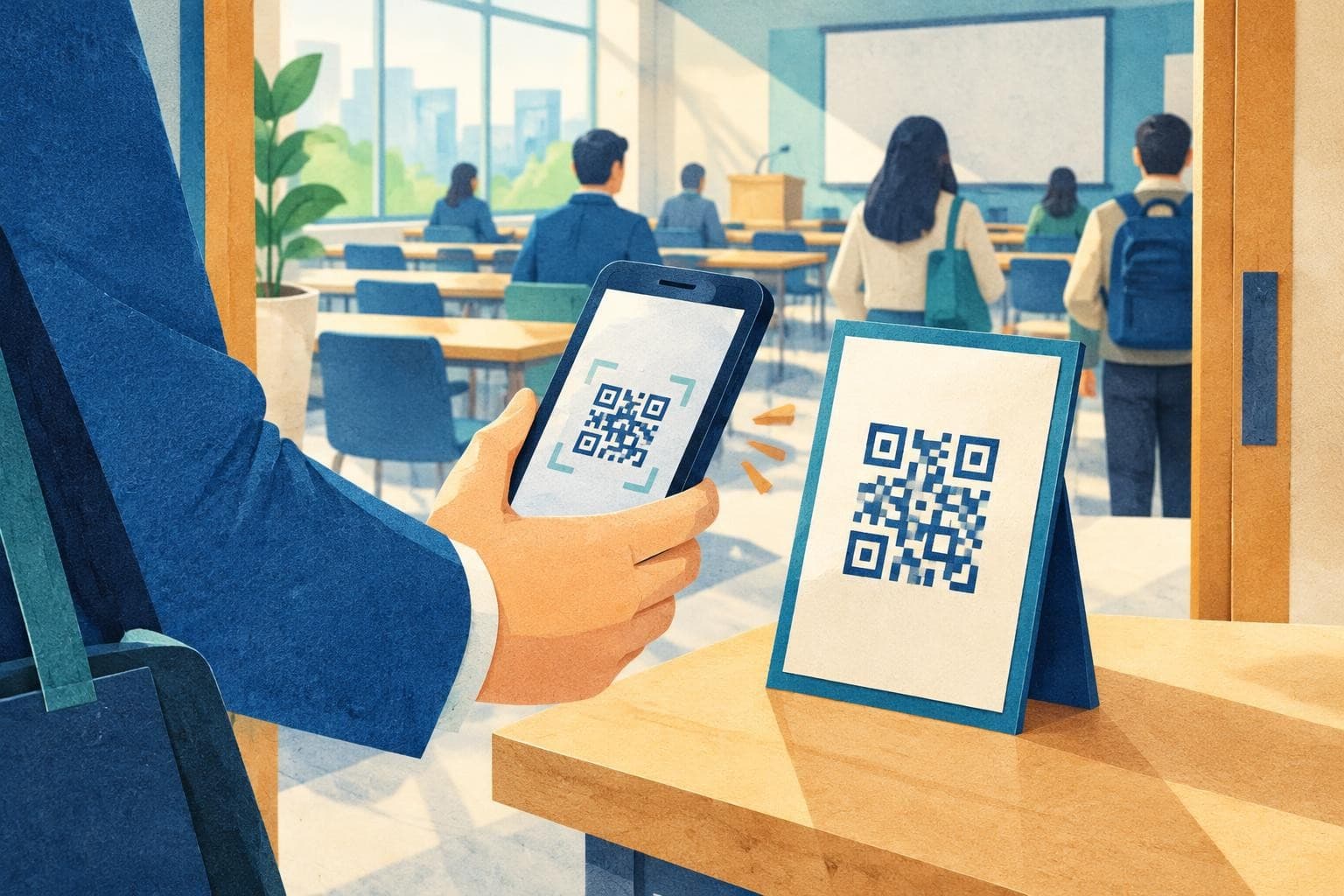
The most concrete example comes from the HR and general affairs team, which used generative AI to develop a QR-code-based attendance system and an in-house training registration system, aiming to cut the repetitive sign-up and roll-call work that accompanied every staff training session. Paper sign-in sheets and the manual re-tallying that followed are gone; scanning the QR code records attendance automatically, and the code changes every 10 seconds to block proxy check-ins. Registration changed too: staff check schedules and remaining seats in the system, full courses put them on a waitlist, a cancellation completes their enrollment automatically, and completion certificates are issued by the system.
The notable part is not adoption but authorship. The agency points to a growing set of cases in which employees themselves build work-automation systems using generative AI, which is a different dynamic from buying and bolting on an external enterprise solution.
From training to tool-building
In the second half of this year, GBSA ran agency-wide generative AI upskilling, with 347 employees taking practice-oriented sessions covering report writing, data analysis, data visualization, and building work tools through vibe coding. The next step was a contest. Following the second-half hands-on training for all staff, the agency held the '2026 GBSA AI Hackathon' on October 2, with 14 teams and 42 participants. The grand prize went to team 'Rabbit²', which developed an AI-based evaluation automation tool covering everything from cross-checking submitted documents for corporate support programs to calculating evaluation scores and analyzing outcomes; it is now being upgraded for use in actual programs. That caveat deserves emphasis: the tool, credited with removing manual work from document review through score calculation, is still in upgrade work ahead of live deployment. Automated scoring is exactly the kind of function where fairness questions arise, so the verdict depends on how it performs once applied.
Compared with the previous phase: paperless first, AI second
This did not start this year. GBSA extended its innovation scope to AI-based workflow automation this year after launching 'paperless accounting administration' in 2024. Its shift to an electronic-document workflow won the top award at the 2025 Gyeonggi Province public institution policy evaluation, and from 2025 through September 2026 the agency saved roughly 470,000 sheets of A4 paper, worth about 76 million won in budget savings.
The two phases being compared are paperless administration and AI-based workflow automation. The paperless phase is presented through budget savings following the shift to an electronic-document workflow, while the AI phase is so far expressed through perceived figures such as 60% of respondents reporting a 30% or greater cut in working time. And the survey base matters: it covers 125 of the 347 employees who completed the second-half AI capability training, so these are answers from a trained group, not an agency-wide average.
What it means in practice
For companies in the province, the tangible change is how much of a program manager's day is available for them. The Pangyo Techno Valley team adopted AI-based market research and trend analysis, cut administrative work by an average of two hours or more per day, and is using that time for follow-up management and on-site consultations with tenant companies in Pangyo. There is a design lesson for practitioners elsewhere, too. As the HR team manager described it, automating manual tasks such as training registration, attendance management, and certificate issuance sharply reduced the administrative burden; the payoff came from high-frequency, highly structured work rather than from any ambitious model deployment.
GBSA president Kim Hyun-gon framed staff capability building as the starting point of AI-driven administrative innovation, saying the agency will concentrate the time freed from repetitive tasks on company consultations and policy planning so that firms in the province feel the difference in support services. The thing to watch next is whether the tools born from the training and the hackathon survive contact with real programs, that is, whether the current upgrade work turns into operating results.
Sources
- "AI로 하루 2시간 절약"…경과원 업무 현장 바꾼 생성형 AI — news.tf.co.kr
- 경과원, 생성형 AI 행정 전면 도입…종이 47만장·7600만원 예산 절감 — fnnews.com