Tech
HD Hyundai's $75B Backlog: AI Is Now a Shipbuilder's Business
8/22/2026
When a Shipbuilder Becomes an AI Supplier
HD Hyundai, the Korean industrial group whose core business is building ships, has reported an order backlog above 110 trillion won (roughly $75 billion) for the first time in its history. Record backlogs are not new for Korean shipbuilders, which have been riding a strong ordering cycle for LNG carriers and container ships. What is new is the composition of the number.
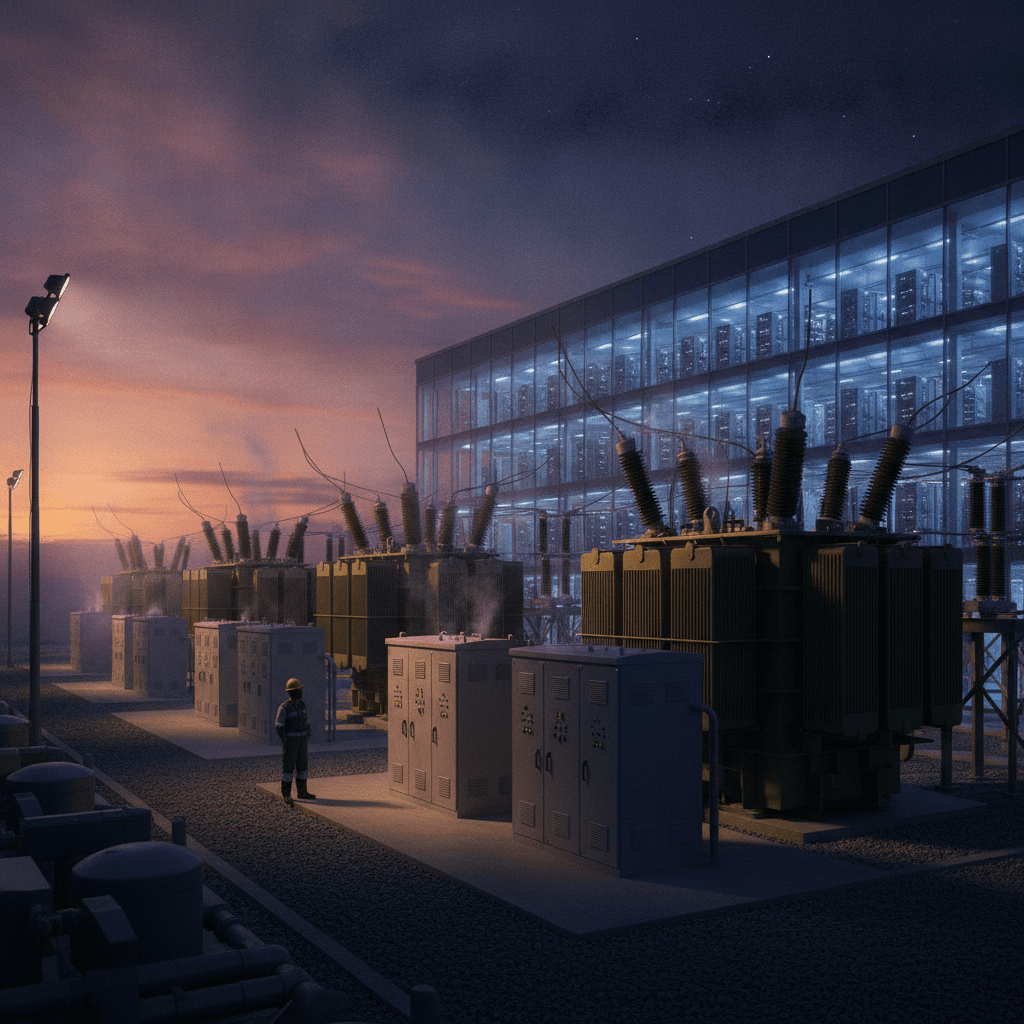
A meaningful share of the growth is coming from units that have little to do with steel hulls. HD Hyundai Electric, the group's electrical equipment arm, signed a long-term supply agreement last month with a global Big Tech company worth up to 1.12 trillion won for distribution and power equipment. A shipbuilding conglomerate is now booking revenue directly from the AI infrastructure boom.
Why Now: The Bottleneck Moved From Chips to Electrons
In the first phase of the AI buildout, the scarce resource was GPUs. Since 2024, the constraint has shifted decisively toward grid power and equipment. A single large training cluster can draw as much electricity as a small city, and a finished data center that cannot get interconnected to the grid produces nothing.
The choke point sits in unglamorous hardware: large power transformers, switchgear, and distribution panels. These are not products you can scale in a quarter. Grain-oriented electrical steel supply is tight, factories require years to qualify, and utility-grade certification is slow. In North America, lead times for large transformers have stretched into multiple years, creating an unusual seller's market where manufacturers, not buyers, set terms.
Korean suppliers — HD Hyundai Electric, Hyosung Heavy Industries, and LS Electric — have all pivoted hard toward this opening, with North America as the growth engine. Historically, Korea's electrical equipment sector was a domestic business dependent on orders from KEPCO, the state utility. Today the marginal customer is a US utility or a hyperscaler.
What Actually Changes
The most interesting detail in the deal is not its size but its structure: a long-term supply contract rather than a one-off order. For the buyer, it locks in delivery slots in a market where slots are the scarce good. For the manufacturer, it converts a volatile order book into multi-year capacity visibility, which is exactly what makes margin forecasting possible.
Compare this with shipbuilding economics. A vessel takes two to three years from contract to delivery, and profitability swings with steel plate prices and the won-dollar rate. Power equipment turns faster, and in the current supply environment cost increases can generally be passed through to price. Shipbuilding still dominates the backlog in absolute terms, but the electrical business is increasingly what defends group profitability.
The engine division follows the same logic through a different door. Data centers require backup generation for outage protection, which means large diesel and gas gensets. A company that historically sold marine engines is now selling into a demand pool created by AI capital spending — a linkage that would have sounded far-fetched a few years ago.
Reading the 200 Trillion Won Talk
Speculation that the backlog could eventually double toward 200 trillion won should be treated as a trend extrapolation, not a forecast. Backlog rises when orders are booked and falls when revenue is recognized, so a swelling backlog also means deliveries pushed further out. Without matching capacity expansion, a bigger backlog can represent lost opportunity as much as future profit.
The risks are concrete. Hyperscaler capex is sensitive to the pace of AI monetization and to broader financing conditions. US tariff policy and pressure for local manufacturing could reshape cost structures for Korean exporters. And competitively, Hitachi Energy, Siemens Energy, and Schneider Electric have all announced significant capacity additions — the current shortage is unlikely to be permanent, and pricing power tends to fade as supply catches up.
The Takeaway
First, industry labels are becoming unreliable. To model a company filed under "shipbuilding," an analyst now needs to track the capital expenditure guidance of American cloud providers.
Second, AI exposure does not live only at the top of the semiconductor stack. Some of the most durable pricing power is appearing in the unglamorous supply chain — transformers, switchgear, cooling, and backup generation — precisely because those are the parts that cannot be scaled quickly.
Third, for engineers and job seekers, this suggests sustained hiring demand in heavy electrical equipment, a field long treated as mature and slow-growing. A sector that spent two decades as a utility-driven commodity business has been pulled back into a growth cycle by AI, and that shift is likely to shape career opportunities for several years.
Sources
Sources
- HD현대, 수주잔고 사상 첫 110조원 돌파…200조원 고지도 밟나 [비즈360] — biz.heraldcorp.com