Auto
Hyundai Up 24% in Japan, Down 20% in China: Why EVs Split the Result
8/28/2026
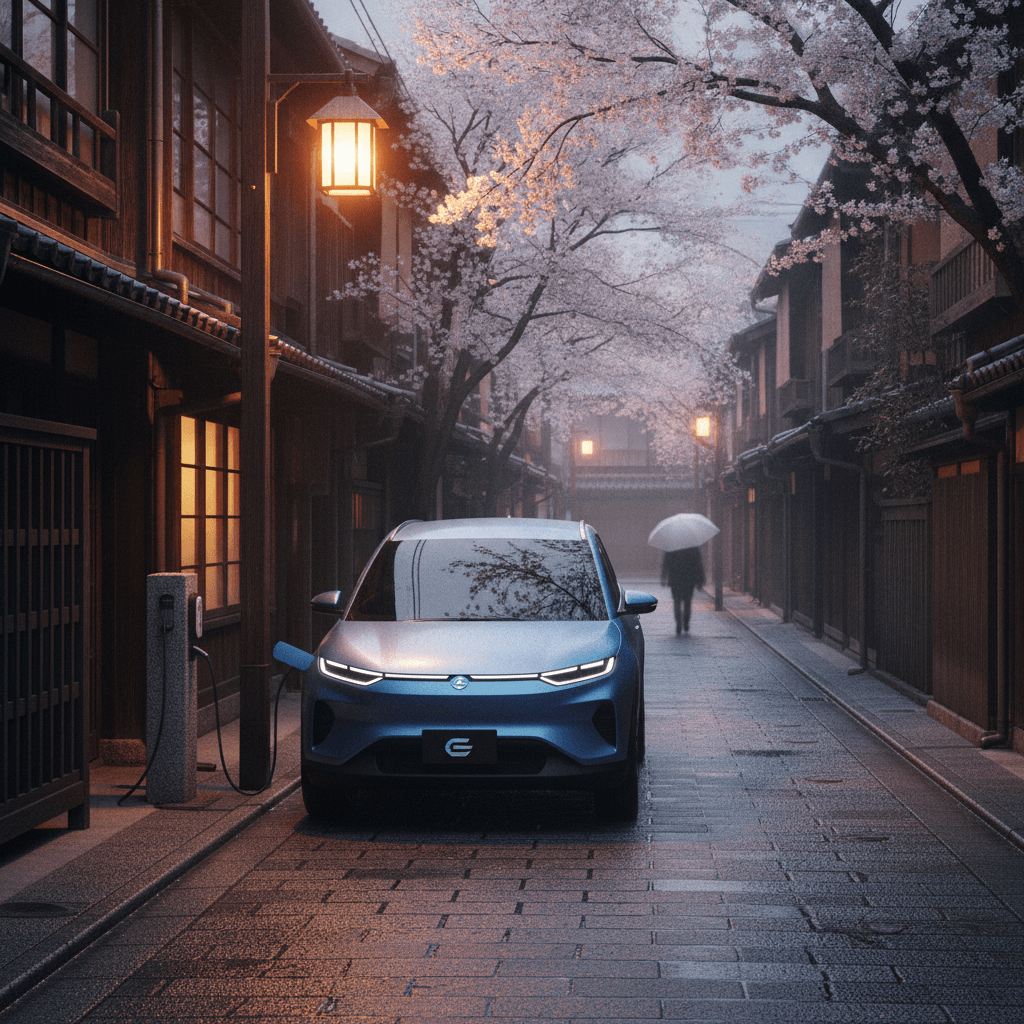
One company, two opposite trajectories
Hyundai Motor's first-half performance in Asia produced an unusual split: sales in Japan climbed 23.7% year over year, while sales in China fell roughly 20%. China remains by far the larger market in absolute terms, but the direction of travel in the two countries could hardly be more different.
The variable most often cited for the divergence is electric vehicles. In Japan, the small EV sold as the Inster — the export name for Hyundai's Casper Electric, a compact city SUV — moved around 320 units in the first half and carried the growth. That number sounds trivial by global standards, but Hyundai's total annual volume in Japan runs only in the low thousands, so a single model can swing the entire growth rate.
Why Japan is finally responding
Hyundai withdrew from Japan's passenger car market in 2009 and returned in 2022 with a deliberately narrow lineup: battery EVs and a hydrogen fuel-cell model only. The logic was that competing against Toyota, Honda and Nissan on combustion engines was hopeless, but that Japanese incumbents had been comparatively slow to field battery EVs. For the first couple of years the strategy produced embarrassing numbers — a few hundred cars a year. That is now changing.
The turning point appears to be size and price. The Ioniq 5 and Kona Electric are simply large and expensive by Japanese urban standards. The Inster is an A-segment electric crossover, close in footprint to Japan's kei car class, which suits narrow streets, tight parking and short daily commutes. Roughly a third of all new cars sold in Japan are kei cars, yet the domestic electric options in that size bracket remain limited — mainly the Nissan Sakura and its Mitsubishi twin. That is the gap Hyundai walked into.
The online-only sales experiment
Hyundai also chose to sell in Japan largely online rather than build a conventional dealer network. That keeps fixed costs low and lets the company test demand cheaply, but it creates real friction around test drives and after-sales service — two things Japanese buyers weigh heavily. Hyundai has been gradually adding physical experience centers and service partners, which suggests the pure online model is being adjusted toward something more conventional.
What went wrong in China
The 20% decline in China is not news so much as the continuation of a decade-long slide. Hyundai sold well over a million vehicles in China in 2016; brand preference collapsed after the 2017 diplomatic dispute over the THAAD missile defense system, and Chinese domestic brands used the following years to close the product gap entirely. The battleground in China today is EVs and plug-in hybrids, and there local players led by BYD are ahead on price, software and speed to market.
The instructive part is that Hyundai's winning card in Japan would be useless in China. There is no small-EV niche to exploit — Chinese brands already saturate every price tier, starting from ultra-cheap city cars like the Wuling Hongguang Mini EV. In other words, the same EV strategy inverts depending on the competitive structure of the market.
Why it matters
First, the numbers suggest Hyundai's overseas approach is shifting away from a one-size-fits-all global lineup toward market-specific product placement. The Inster's traction confirms that an electrification portfolio built around midsize and large crossovers has a hole at the bottom.
Second, there is a read-across to Europe. European demand for A- and B-segment EVs is substantial but poorly served, and several affordable small EV programs — the Renault Twingo revival and Volkswagen's entry-level ID models among them — are queued up for the next two years. Affordable small EVs look like the next genuine battleground rather than another round of premium SUVs.
Third, for consumers this means widening choice. The EV market has skewed toward large, expensive vehicles because that is where margins are. More small cars with modest but sufficient batteries lowers the entry barrier for buyers who want a second car or a pure commuter.
A necessary caveat on scale
It is worth keeping the Japanese rebound in proportion. Japan sells more than four million new vehicles a year; 320 units of one model is statistically close to noise, and a high percentage gain from a small base is easy to achieve and easy to lose. Nor does one strong half-year prove that a foreign brand can build durable share in a market that has resisted imports for decades — import brands collectively account for only a modest slice of Japanese sales, and most of that is German premium.
The more defensible conclusion is narrower but more useful: lineup composition decides outcomes. Hyundai did not win in Japan by improving its brand image or its dealer network; it won by finally offering a vehicle shaped like what that market actually buys. And it is losing in China for the mirror-image reason — its products no longer sit in a gap, because there is no gap left. For any automaker planning its next round of EV investment, that contrast is more actionable than the headline growth rate.
Sources
Sources
- 전기차 성적표가 갈랐다…현대차, 상반기 日 24%↑·中 20%↓ — mk.co.kr