Seoul Fire Probe Triggers Recall of 6,144 E-Motorcycles
When a Fire Investigation Becomes a Recall
An analysis of electric two-wheeler fires by the Seoul Metropolitan Fire and Disaster Headquarters has resulted in a recall covering 6,144 vehicles. That path is unusual. In Korea, vehicle recalls typically begin with a manufacturer's own quality review or with a defect investigation by the Ministry of Land, Infrastructure and Transport and the Korea Transportation Safety Authority. Here, the trigger was forensic fire analysis carried out by a municipal fire service.
Fire investigations normally exist to answer a narrow question: why did this particular fire start? The fact that the findings scaled up from individual incidents to a corrective action across an entire model population points to something specific about batteries — failures often trace back to design and manufacturing characteristics rather than to how any one owner used the vehicle.
How Owners Check Whether They're Affected
Korean owners can look up recall status at the Korea Automobile Recall Center (www.car.go.kr), entering either a vehicle registration number or a VIN. Electric motorcycles above a certain classification are registered vehicles in Korea and carry plates, so the lookup is straightforward.
Manufacturers are also required to notify affected owners directly by mail and text message. In practice, though, those notices go astray more often than the system assumes. Ownership changes hands through informal used sales, and in the delivery sector a vehicle is frequently registered to a fleet operator while a different person rides it daily. If you bought a used electric motorcycle, checking the VIN yourself is more reliable than waiting for a letter.
Why Two-Wheelers Are a Distinct Risk Category
Electric motorcycles operate their batteries under conditions quite different from passenger EVs. In dense urban delivery work — the dominant use case in Seoul — a rider may charge and discharge multiple times in a single day, often at high rates to keep the vehicle in service. The packs are small, and the thermal headroom is limited, which makes them comparatively vulnerable to heat buildup.
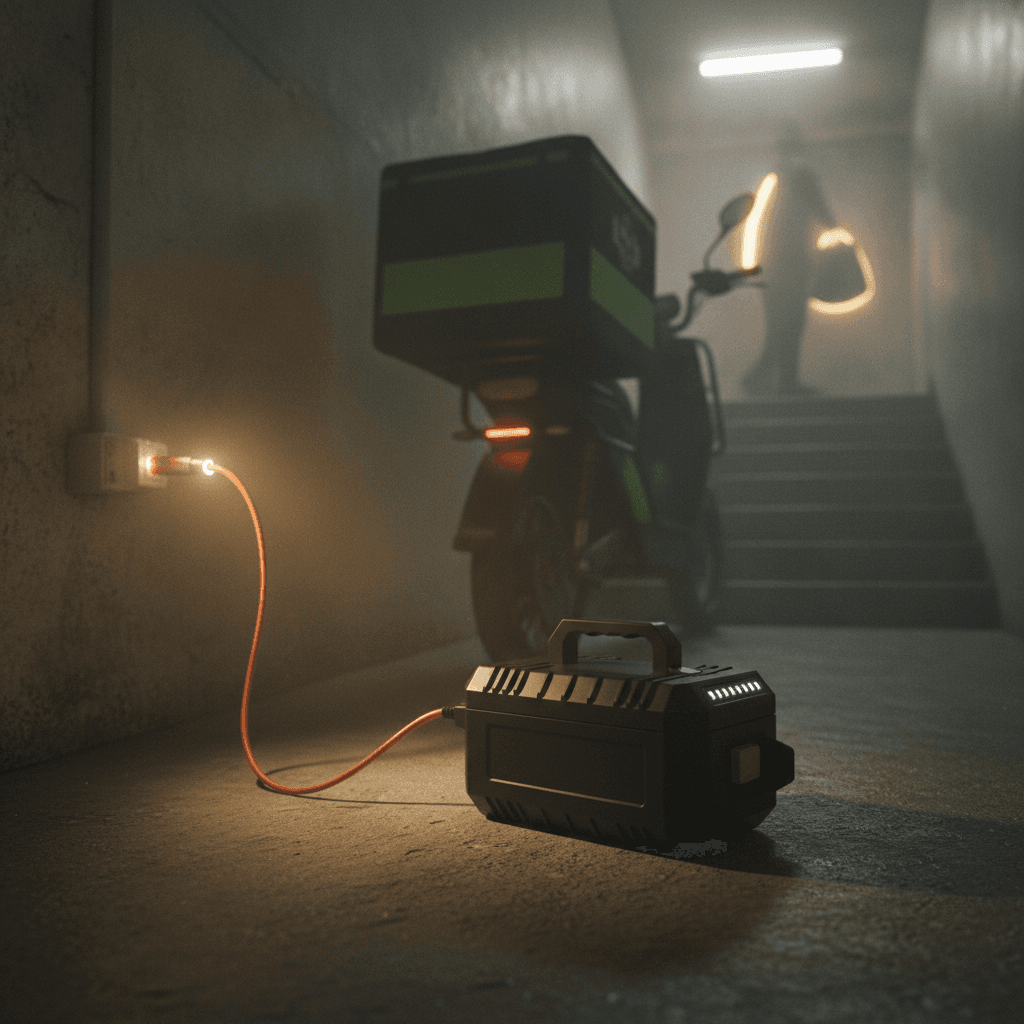
Charging environments compound the problem. Passenger EVs are almost always plugged into fixed, purpose-built chargers. Many two-wheeler batteries, by contrast, are removable, and riders carry them indoors — into apartment corridors, stairwells of multi-unit buildings, or the back rooms of small shops. A fire that starts in an escape route is a categorically more dangerous fire than one in an open parking deck.
Market structure matters too. Korea's electric two-wheeler segment is fragmented across many small domestic brands and imported models, with cells, packs, and chargers frequently sourced from different suppliers and combined downstream. Every additional permutation makes consistent quality control harder to guarantee.
A Recall Is a Safety Process, Not a Verdict
Consumers tend to react to the word "recall" in one of two unhelpful ways: alarm, or procrastination. Neither fits. A recall is the mechanism by which a manufacturer confirms a potential defect and corrects it, and the remedy is provided free of charge. Deferring the fix also complicates any later claim, since an unrepaired vehicle involved in an incident invites disputes over liability.
The practical obstacle is time. Unlike car owners, motorcycle riders often have no habit of routine service visits, and for delivery workers a day in the shop is a day of lost income. Unless manufacturers and delivery platforms build in scheduling flexibility or loaner arrangements, actual completion rates for this recall may lag well behind the headline number of affected units.
The Harder Problem Is Upstream
The significance of this case lies less in the unit count than in the fact that fire-scene data successfully fed into a formal corrective action. That channel working is genuinely good news. But it remains, by definition, a response after the fact.
The upstream work is less developed: certification standards for battery packs, clear guidance on indoor charging of removable batteries, and controls on charger-to-pack compatibility, where mismatched combinations are a known hazard. Electric two-wheelers are now core infrastructure for urban logistics in Korea and their numbers keep growing. In a housing environment where a single battery fire can block the only exit path in a multi-unit building, turning accumulated incident data into preventive standards is closer to a necessity than an option.
For an individual owner, the immediate action is far simpler: run the VIN through the recall center, and if the vehicle is listed, don't put off the appointment.
Sources
- 서울시, 전기이륜차 배터리 화재 검증… 6144대 리콜 — newscj.com
- 서울시, 전기 이륜차 배터리 화재 분석...6천여 대 리콜 — ytn.co.kr
- 서울시, 전기 이륜자동차 배터리 화재 분석…6천여 대 리콜 이끌어 — m-i.kr