Hyundai's First Full Strike in a Decade Hits at the Worst Time
A six-year streak of labor peace ends
Hyundai Motor's union has walked out in a full-scale strike, its first in 10 years. That ends a run of six consecutive years of contract settlements reached without industrial action — an unusually long stretch of calm at a company that, for much of the 2000s and 2010s, treated summer wage negotiations as an annual standoff.
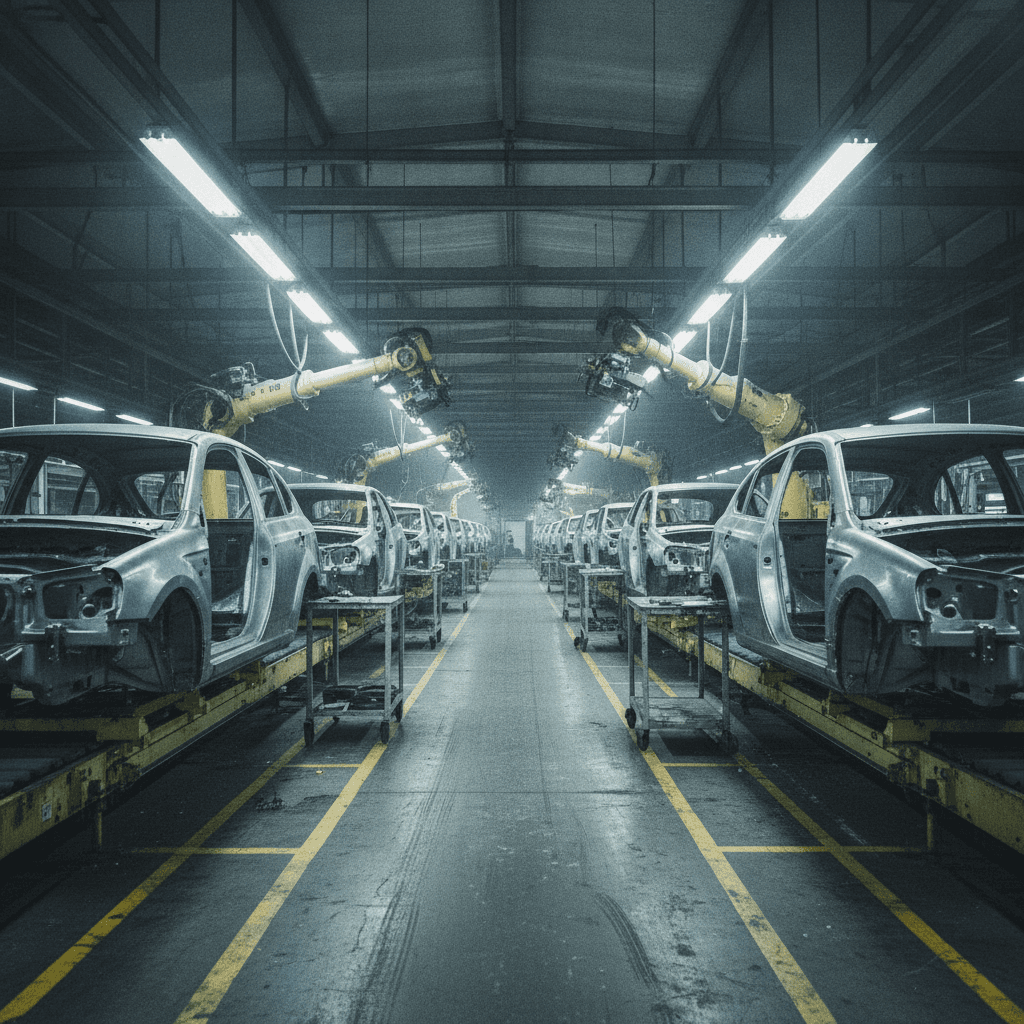
The distinction matters. Hyundai's union has staged partial walkouts and overtime refusals in recent memory; a full stoppage halts the assembly lines outright. Two issues sit at the center: an extension of the retirement age and the reinstatement of previously dismissed workers. Neither is the kind of demand that can be split down the middle. A retirement-age extension reshapes headcount planning, total labor cost, and how production workers are redeployed during the shift to electrification. Reinstatement is symbolic rather than financial — and once granted, it sets a precedent. That structural quality is a large part of why this round of bargaining looks harder to close than the last several.
Why the timing is brutal
Hyundai is heading into a dense new-model cycle. The Elantra, Tucson and Santa Fe — the volume backbone of its lineup in Korea and abroad — are in play this year, alongside the GV90, the flagship SUV that Genesis, Hyundai's luxury brand, is preparing as a halo product.
In the car business, the first three to six months after launch usually decide a model's commercial arc. Pre-orders concentrate at the start; if the factory can't fill them, wait times stretch, and stretched wait times convert into cancellations and defections to rival models. Korea's domestic market has repeatedly seen popular SUVs run multi-month delivery backlogs even without labor disruption, so a production halt now points straight toward longer delivery queues. Lost line hours are only partially recoverable through weekend overtime; they are never fully recovered.
The external squeeze
Korean automakers are absorbing three pressures at once: US tariff policy risk, aggressive low-price expansion by Chinese manufacturers, and intensifying price and technology competition in EVs. None of those can be negotiated away by a single company. Which makes production stability — the one controllable variable — disproportionately valuable right now. When external shocks are large, a self-inflicted supply gap simply hands share to someone else.
Chinese brands are the sharpest example. Their edge in emerging markets and Europe is not only price but development speed and the ability to deliver volume quickly. In that contest, a brand that can't ship is structurally disadvantaged, regardless of how good the product is.
How this differs from past Hyundai strikes
Through the mid-2010s, Hyundai labor disputes were close to a seasonal ritual. The decisive difference today is the industry's clock. Back then the internal-combustion market was stable and a lost quarter could be recouped in the next one. Now the transition to electrified, software-defined vehicles is underway, and the success or failure of a single launch feeds into platform strategy for years afterward.
The nature of the demands has also shifted. Where earlier disputes revolved around pay, this one centers on how long jobs will last. That is hard to separate from anxiety about electrification: EVs generally use fewer parts and require less assembly labor than combustion vehicles. Read that way, the retirement-age demand is less a welfare item than an expression of transition-era job insecurity — which is exactly why it resists a quick cash settlement.
What it means for buyers
For anyone shopping a Hyundai or Genesis right now, three practical points.
Delivery timing is the main uncertainty. A short strike would have limited effect; a prolonged one typically lengthens waits for popular trims and colors first. Ask a dealer for a specific estimated delivery window before signing, and get it in writing where possible.
Second, incentives may tighten. Discounting tends to shrink when inventory is thin. The reverse is also possible: if the strike ends quickly and backlogged output floods out at once, terms could improve. Either way, this is a period of unusually high variability in purchase conditions rather than a clear buy-or-wait signal.
Third, used values. If new-car deliveries slip, some demand migrates to nearly-new used inventory, which can firm up prices for those models in the short term. How much depends entirely on the length and scale of the stoppage, so it's too early to treat as a given.
Duration is everything
The headline is the strike; the variable that matters is how long it runs. A stoppage measured in days can largely be made up through overtime and line rescheduling. Once it runs into weeks, the effect cascades into the supplier base. Many Korean parts makers derive a heavy share of revenue from Hyundai Motor Group orders, so an idle assembly line quickly becomes a direct revenue hit for suppliers with far thinner balance sheets than the automaker.
Both sides understand that arithmetic. But structural issues like retirement age rarely resolve in a single bargaining round. Whatever settlement emerges is likely to become a reference point for employment and production talks across Korea's auto sector for years — which gives this dispute more weight than a routine annual negotiation.
Sources
- 현대차 노조, 10년 만에 '전면파업'…신차 줄줄이 앞두고 손실 '눈덩이' — dailian.co.kr
- 현대차 노조 10년 만에 전면파업…정년 연장·해고자 복직 놓고 충돌 — thepublic.kr