Korea's First Outdoor Self-Driving Parking Robot Debuts
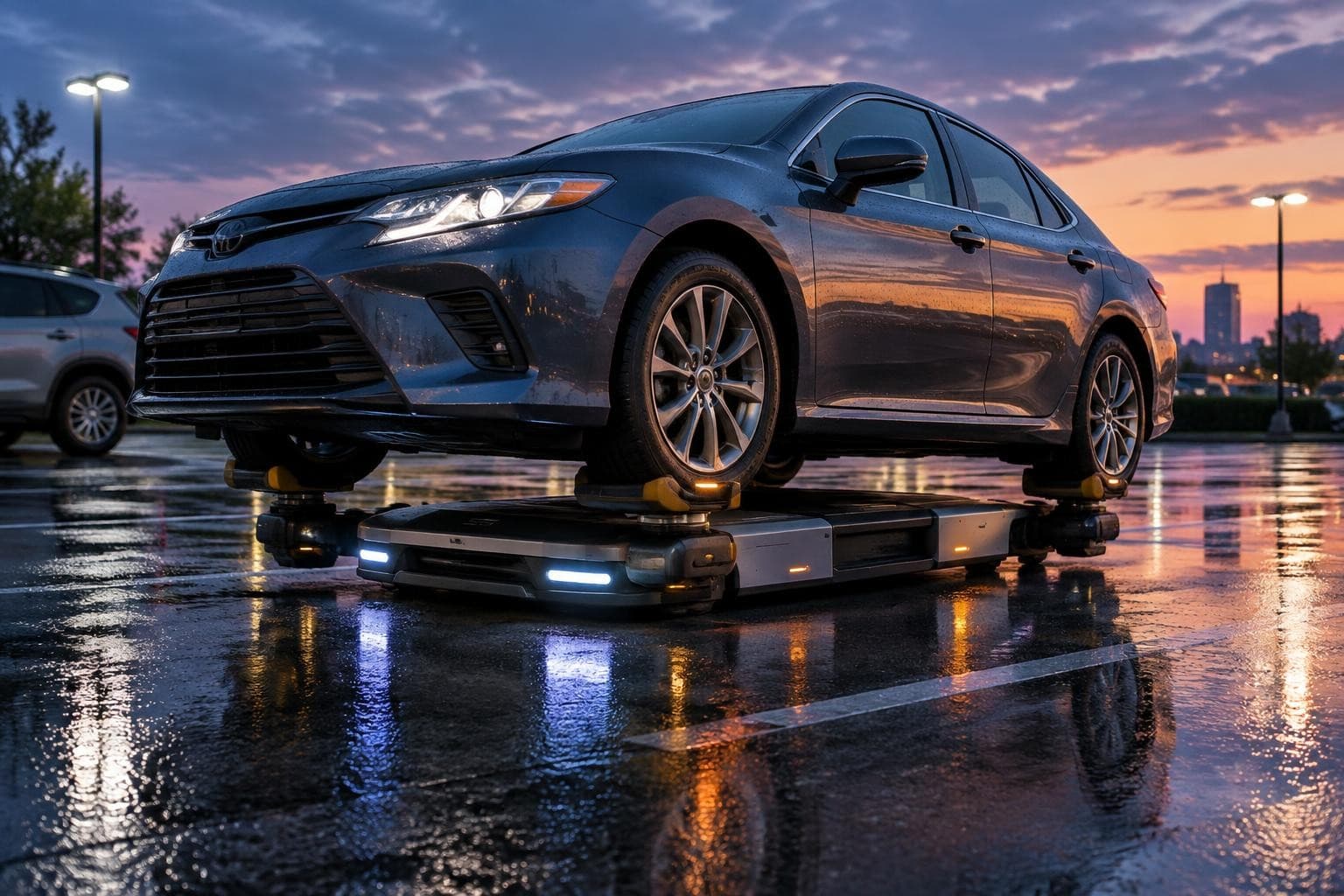
What's happening
HL Robotics, a wholly owned subsidiary of Korea's HL Holdings, is giving the domestic debut to STAN, an outdoor autonomous parking robot the company bills as a world first. The venue is the 32nd ITS World Congress, held October 19–23 at Olympic Park in Gangneung, on Korea's east coast.
What sets this apart from a typical trade-show mockup is the setting. HL Robotics plans to run two STAN units in the Gangneung Hockey Centre parking lot, demonstrating the full cycle — vehicle intake, autonomous parking, and retrieval — in a live outdoor environment where weather, pavement condition, and lighting aren't controlled.
Why "outdoor" is the hard part
Parking robots themselves aren't new. Versions have been deployed at airports and shopping-mall garages in Europe and China, and Korea has seen several pilots. But nearly all of them operated in underground or indoor garages. The reason is straightforward: indoor floors are flat, lighting is consistent, and robots can rely on floor markers or indoor positioning infrastructure instead of GPS, so the risk of losing localization is low.
Outdoors, the variables multiply. Rain, snow, and ice change surface friction; there are slopes and uneven pavement; glare and low nighttime light interfere with sensors. That difficulty gap is where the "world first" claim rests. The genuinely hard engineering here is likely not the lifting mechanism that picks up a car, but localization and stability in uncontrolled conditions.
Two paths to driverless parking
There are broadly two ways to get a car parked without a driver. One is to build the capability into the vehicle itself — Automated Valet Parking, the route most automakers have pursued. The other is to have a robot physically move the car.
The practical advantage of the robot approach is that it is vehicle-agnostic. A ten-year-old combustion car and a brand-new EV are handled identically once the robot grips the wheels and lifts. There's no waiting for software updates or industry-wide communication standards. The trade-off: it requires upfront investment on the facility side and must be operated by the parking operator, which makes it a B2B infrastructure product rather than something a consumer buys.
That framing explains why HL Robotics says it is targeting vehicle logistics alongside parking. Factory outbound yards, used-car auction lots, port storage areas, and rental-car depots — outdoor sites where hundreds or thousands of cars are shuffled by human drivers — are the closest fit for an outdoor parking robot's business case.
What actually changes
For ordinary drivers, the practical impact is still some distance away. Adoption will most plausibly start at sites with high turnover and heavy labor costs, such as airport long-stay lots and large mixed-use complexes. The most direct incentive for operators is density: when a robot moves the car, nobody needs room to open a door and step out, so spaces can be packed tighter and more vehicles fit in the same footprint.
For industry watchers, the more interesting angle is HL Group's structure. Formerly the Halla Group, HL is built around HL Mando, a major Korean auto parts supplier with autonomous-driving sensor and control technology. Pairing that with a robotics subsidiary reflects a broader pattern: suppliers moving beyond OEM parts into services and infrastructure as electrification and autonomy squeeze traditional component margins.
The open questions
A five-day demonstration is not commercial operation. Performance on iced-over pavement or in heavy rain, how many vehicles a single robot can handle per hour, and the payback period against installation and operating costs have not been disclosed. Liability and insurance rules also get thornier outdoors than in a closed garage. How convincingly Gangneung answers those questions will determine whether STAN stays a showcase or moves onto real sites.
Sources
- HL로보틱스, '세계 최초' 실외 자율주행 주차 로봇 첫선 — news1.kr
- HL로보틱스, 세계 최초 실외 자율주행 주차 로봇 '스탠' 공개…강릉서 ... — newsis.com
- HL로보틱스, 실외 자율주행 주차 로봇 '스탠' 국내 첫 공개 — mt.co.kr
- HL로보틱스, 실외 자율주행 주차 로봇 '스탠' 강릉서 국내 첫 공개 — edaily.co.kr
- HL로보틱스, ‘2026 강릉 ITS 세계총회’서 실외 자율주행 주차 로봇 ‘... — sportschosun.com