Data-center cooling explained: air, liquid, CDUs and chillers
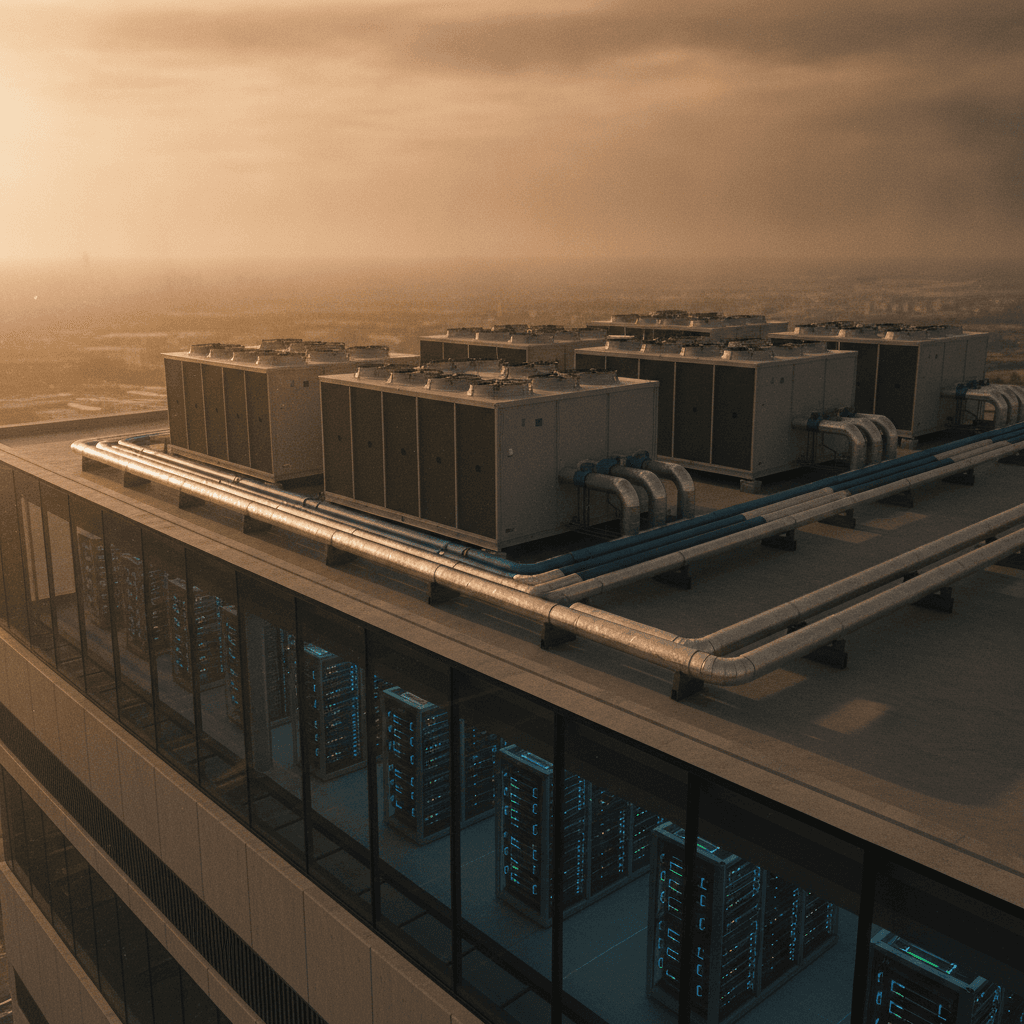
Data-center cooling announcements become easier to compare when you separate equipment serving chips, room air, and the wider facility. Samsung's India factory and LG's liquid-cooling announcements describe different parts of that system.
What Samsung announced in India
Samsung's August 13, 2026 release identifies AHUs, fan-wall units and CRAHs as products for its subsidiary FlaktGroup's Pune facility. Up to 6,500 units annually is a capacity expansion plan, not completed sales. Air-handling equipment can use chilled water without delivering coolant directly to a chip. Samsung announcement
A factory opening does not establish customer orders, utilization or recurring service revenue. Those require separate evidence.
What the cooling terms mean
LG's April 2026 exhibition included direct-to-chip cooling using cold plates and CDUs, immersion systems that place equipment in dielectric liquid, and facility equipment including CRAHs and an air-cooled centrifugal chiller. These are different components, not interchangeable names for one product. LG exhibition announcement
LG's July announcement describes NVIDIA infrastructure validation for a 600kW CDU. A CDU distributes and manages server-side coolant; the chiller belongs to the facility's cooling-supply side. Validation is not evidence of an exclusive supply contract or a specific customer's purchase value. LG CDU announcement
A practical comparison checklist
This is our reading checklist, not a product ranking:
- Identify the location: chip, rack, room or facility. Compare equipment doing the same job.
- Check the unit: factory units per year cannot be compared with the cooling capacity of one CDU.
- Name the stage: exhibition, validation, production, customer delivery and recognized revenue are different milestones.
- Ask about test conditions: an efficiency percentage needs a baseline, workload and environmental conditions before it can be applied elsewhere.
- Ask about operation: check plumbing compatibility, leak response, maintenance downtime and integration with existing air handling.
For example, if one company reports factory capacity and another reports CDU capacity, neither number establishes a technology lead. First ask whether comparable equipment specifications and test conditions are available.
Can these releases identify a winner?
No. The documents address different questions. Our conclusion is to compare product roles and commercial milestones before comparing company names. Company releases describe the vendors' positions; this article is not an independent performance test.
For another part of AI infrastructure, see FC-BGA and what LG Innotek's earnings do not prove.
Revised September 14, 2026: checked official product descriptions and capacity plans; removed unsupported market-size and long-term earnings assertions. Original publication date and URL retained.
Sources
- Samsung: FlaktGroup Pune HVAC facility, 2026-08-13 — Samsung Electronics
- LG: Data Center World cooling portfolio, 2026-04-21 — LG Electronics
- LG: NVIDIA infrastructure validation for 600kW CDU, 2026-07-27 — LG Electronics
- 14억 시장에 AI 인프라까지…삼성·LG, 인도서 냉난방공조 정조준 — it.chosun.com