Hydraulic Press Fire at Korean Auto Parts Plant Doused in 40 Minutes
What happened
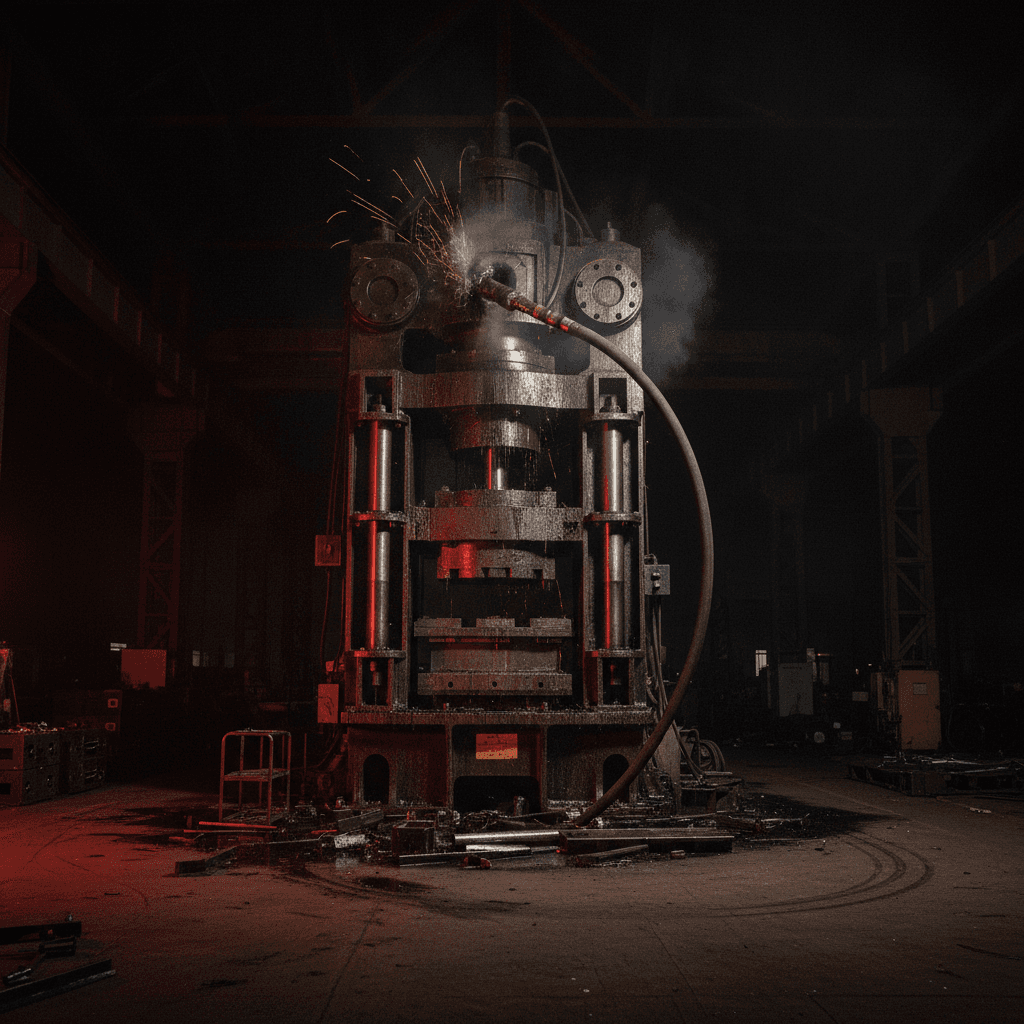
At around 2 a.m. on the 14th, a fire started at an auto parts manufacturing plant in Wangam-dong, Jecheon, in South Korea's North Chungcheong Province. A worker on the night shift noticed flames coming from a machine and called it in. The fire burned part of a hydraulic press hose and was extinguished in roughly 40 minutes.
Fire authorities estimated property damage at about 2.5 million won (roughly $1,800) — trivial by industrial-fire standards. There were no injuries. Police and fire officials are still investigating the cause.
Why a small fire is worth noting
On damage alone, this barely registers as news. What makes it worth a closer look is where it started: the hydraulic press. Presses are core equipment in auto parts plants, circulating high-pressure hydraulic oil to form sheet metal and components. That oil is flammable, and when an aging high-pressure hose develops a pinhole failure, it can atomize the fluid into a fine mist. Add friction heat or an electrical spark and ignition is nearly instant.
In other words, this wasn't a freak accident — it fits a well-known failure pattern shared by any factory running press lines. The 2 a.m. timing is also typical: many Korean parts suppliers run around the clock, and night shifts are the thinnest staffed.
What 40 minutes and 2.5 million won actually tell us
The meaningful detail here is the early response. Because an operator saw the fire at the machine and reported it immediately, the loss stopped at a partially burned hose. Hydraulic fires spread fast as long as oil keeps feeding them, and press areas often accumulate lubricants, cutting fluid and oil-soaked rags. Lose the first few minutes and the damage can jump from one machine to an entire line, or the building.
Larger fires at Korean auto parts plants have repeatedly shown that the real cost is driven less by the burned equipment than by downtime. The auto industry runs on just-in-time supply, with automakers holding thin inventories, so when a specific die or press line at a tier-1 or tier-2 supplier stops, there is rarely a quick substitute. Equipment damage worth a few thousand dollars can sit alongside indirect losses orders of magnitude larger. A 40-minute knockdown kept that scenario off the table this time.
Practical takeaways
For plant managers, the lesson is unglamorous: hydraulic hoses are consumables, and you cannot judge replacement timing by visible wear alone. Hoses repeatedly flexed under high pressure degrade from the inner layers first, so an outwardly intact hose can still fail. Keeping oil residue off the press area, making sure extinguishers are genuinely reachable at each machine, and drilling the night shift on first response are the mundane items that separate a 2.5 million won loss from a catastrophic one.
For consumers, this fire has no bearing on vehicle quality or supply. But it is a reminder that a single car is assembled from tens of thousands of parts produced on machines that are still running at 2 a.m. in small and mid-sized plants — and that the safety discipline on those lines feeds directly into automotive supply chain stability.
Sources
- 충북 제천 자동차부품업체 화재… 40분 만에 진화 — daejonilbo.com
- 제천 자동차 부품 공장 화재…250만원 피해 — newsis.com