Why EV Fires Now Headline Seoul's Disaster Drills
What happened
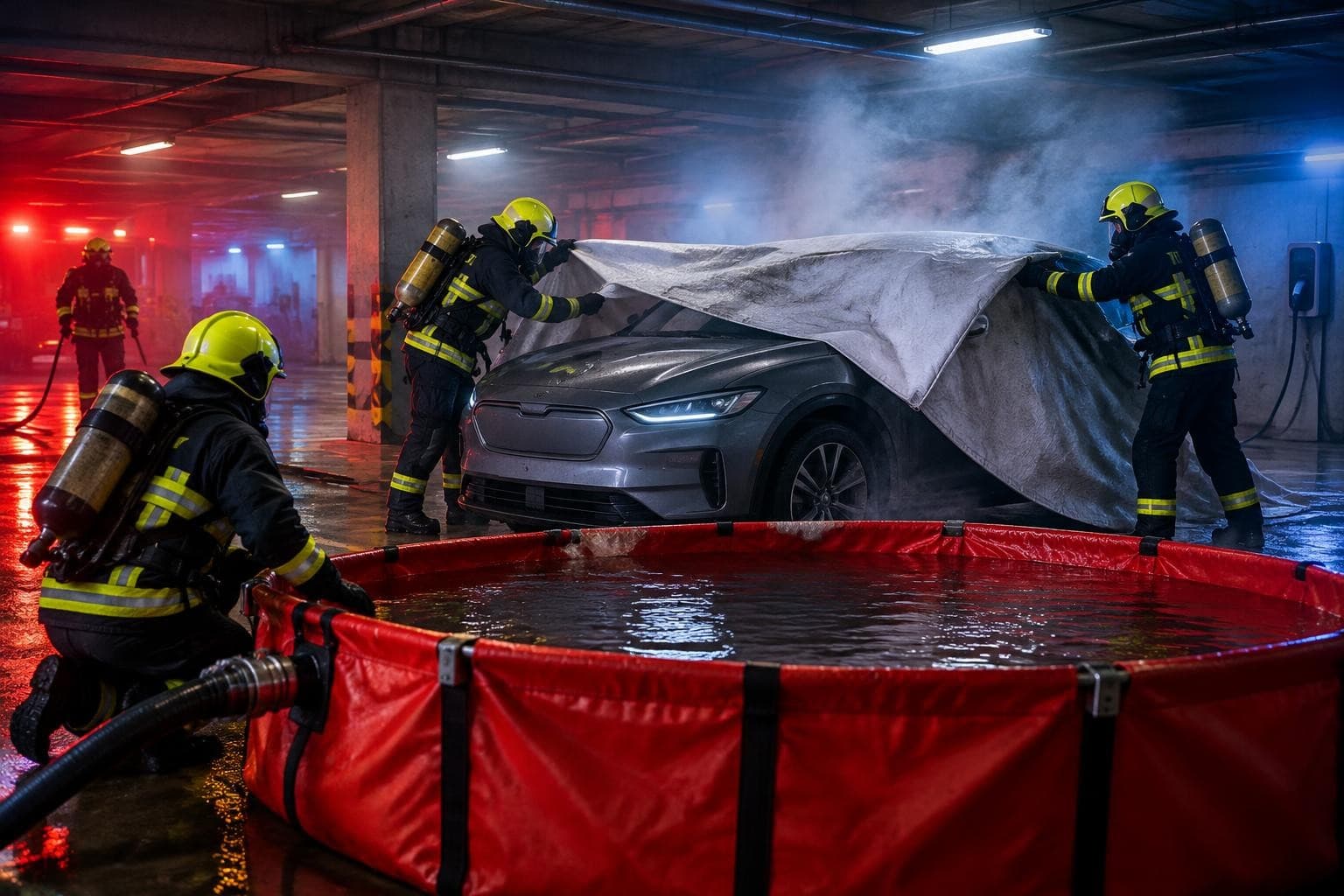
The Seoul Metropolitan Government ran a complex-disaster exercise built around a chain of cascading emergencies: an earthquake triggering ground subsidence, followed by structural collapse, followed by an electric vehicle fire. Rather than rehearsing a single incident, the drill tested whether multiple agencies — fire, roads, buildings, utilities — can operate as one coordinated response. Recent real-world incidents in central Seoul, including a sinkhole in the Myeongil-dong area, shaped the scenario design.
The notable detail is not that an EV fire was included, but how it was included: not as an exotic new-technology edge case, but as a standard item in urban disaster planning, listed alongside subsidence and collapse.
Why this is happening now
Two trends put EV fires on the standing agenda of Korean emergency drills. The first is sheer volume. EV registrations in Korea have grown fast, and in a country where most residents live in high-rise apartment complexes with large underground parking garages, the number of EVs parked indoors at any given moment is unlike anything fire services planned for a decade ago.
The second is public sentiment following the 2024 underground garage fire at an apartment complex in Cheongna, Incheon, which destroyed or damaged a large number of vehicles and became a national talking point. That incident drove policy debate over where chargers may be installed, sprinkler performance requirements, and recommended state-of-charge limits for indoor parking, while fire authorities expanded deployment of EV-specific gear such as fire blankets and portable immersion tanks. This latest drill essentially asks whether that equipment and those manuals still function when another disaster overlaps.
How this differs from a conventional EV fire drill
Standard EV fire training in Korea has typically assumed one car burning in an otherwise intact garage. The focus was access, thermal runaway suppression, and smoke ventilation.
A cascading scenario removes those assumptions. If the ground has subsided or part of a structure has collapsed, fire truck access routes may no longer exist, and water supply or electrical power to the garage may be cut. Lithium-ion battery fires are fought mainly by applying large volumes of water over long periods to cool the pack — a method that depends entirely on water access and a workable approach path. Remove either and the standard playbook stops applying. That dependency is likely why Seoul emphasized inter-agency integration rather than firefighting capability alone.
What it means for owners and the industry
For EV owners, a municipal drill does not change anything about the car itself. But repeated appearances in official scenarios can reasonably be read as a signal of tightening building rules. Debates over charger placement in underground levels, fire compartmentalization, and sprinkler standards continue at the level of local ordinances and building codes. Whether new apartments and commercial buildings put chargers above ground or below will directly affect everyday convenience for drivers.
For automakers and battery suppliers, the pressure takes a different form. Battery management system diagnostics that flag anomalies before a fault escalates, charge-limit functions, and cell-to-cell thermal propagation delay are drifting from marketing features toward factors tied to permits, insurance and building rules. Several manufacturers already promote BMS alerts sent directly to owners — less a consumer convenience than a response to social and regulatory expectation.
Between panic and complacency
One clarification matters: the prominence of EV fires in drills does not establish that EVs catch fire more often than gasoline cars. What these exercises target is not frequency but suppression difficulty in enclosed spaces. Lithium-ion fires can reignite repeatedly through internal heat generation, demanding extended water application, and a sealed underground garage traps heat and smoke by design. Those two conditions compound each other.
The practical takeaway for consumers is therefore about environment rather than vehicle choice. Knowing where chargers sit in your building, whether sprinklers cover that area, and what the evacuation route looks like is far more useful than general anxiety. The message of this drill is less "avoid EVs" and more a question about whether urban infrastructure has kept pace.
Sources
- 전기차 화재, 땅꺼짐 등 연쇄 재난 대응 훈련 — news.kbs.co.kr
- 지반침하·전기차 화재 등 실전 대응 점검…서울시 복합재난훈련 — yna.co.kr