Paint Booth Fire at Korean Auto Shop: Why Refinishing Burns
What happened
At around 9:54 a.m. on October 26, a fire broke out at an auto repair shop in Ojeon-dong, Uiwang — a city in Gyeonggi Province just south of Seoul. Firefighters deployed roughly 60 personnel and about 30 pieces of equipment, and the blaze was out by 10:35 a.m., roughly 40 minutes after it started.
The building is a two-story steel-frame structure with a total floor area of 1,221 square meters. Everyone inside evacuated and no injuries were reported, while vehicles that were being worked on burned. Police believe the fire began during heat-curing of a vehicle paint job and are investigating the exact cause.
Why paint work is the most fire-prone step in a body shop
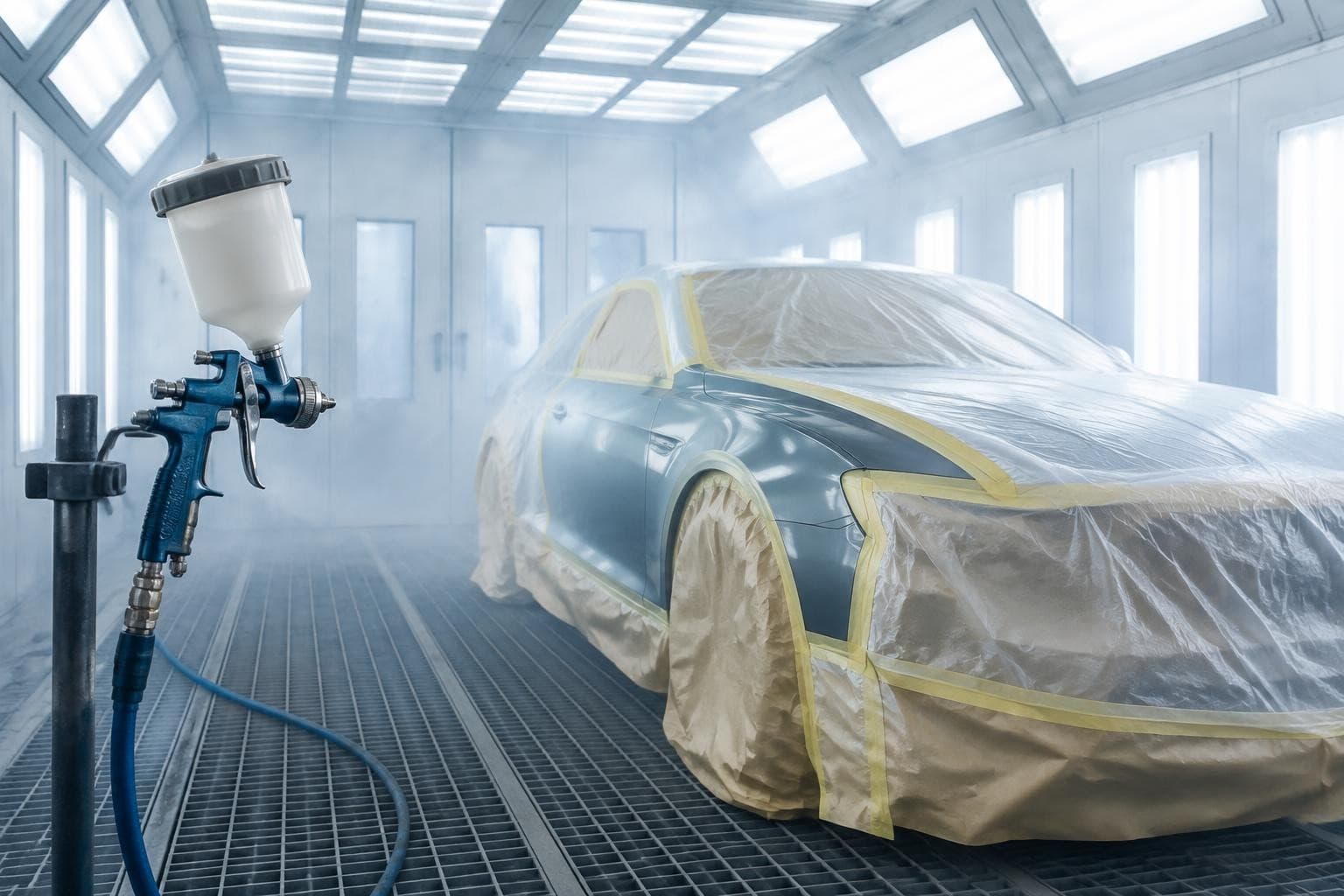
Automotive refinishing is structurally among the highest fire-risk operations in any repair facility. Paints, thinners and primers contain large amounts of volatile organic solvents, and spraying puts both fine paint particles and solvent vapor into the air. Add a heat-curing stage to harden the coating, and you have flammable vapor and a high-temperature heat source sharing the same enclosed space.
The official cause is still under investigation, so no specific piece of equipment or act of negligence can be blamed. But the fact that investigators are pointing to the heat-curing step lines up with a well-known property of paint booths: safety depends on ventilation performance and heat-source control working simultaneously. When ventilation is inadequate and solvent vapor accumulates, even a small ignition source can spread combustion rapidly.
Why the damage stayed limited
The same day saw other road incidents reported in the region, including a seven-vehicle chain collision in nearby Pyeongtaek caused by a driver running a signal. The Uiwang fire, by contrast, was contained quickly. A steel-frame building behaves differently from timber or sandwich-panel construction in the early spread phase, and — more importantly — the fire started during working hours, so staff noticed it immediately and got out. Had the same conditions occurred overnight in an unattended shop, delayed detection could have produced a very different outcome.
What this means for car owners and the trade
For anyone who has left a car at a shop, this is not an abstract risk. If a vehicle burns while in for repair or refinishing, whether the recovery comes through the shop's liability insurance or the owner's own auto policy changes both the process and the amount recovered. Before handing over a car for bodywork or paint — jobs that keep a vehicle on site for days — it is worth confirming the shop's fire liability coverage in advance.
For the trade, the incident is a reminder of the core control points: inspection intervals for booth ventilation, temperature control on curing equipment, physical separation of paint and thinner storage from heat sources, and purge procedures for residual vapor after a job ends. One seasonal detail matters here — as temperatures drop, shops are tempted to cut ventilation to keep the workspace warm, which pushes vapor concentration upward in exactly the wrong direction.
Sources
- 의왕 자동차 정비소에서 화재..."도색 중 화재 추정" — ytn.co.kr
- 의왕 자동차 정비소 화재, 40분 만 진화…인명 피해 없어 — newsis.com
- 의왕 자동차 정비소 화재...평택에서 7대 추돌 사고 — ytn.co.kr
- 의왕 오전동 자동차 관련 시설 화재...인명피해 없어 — news.skbroadband.com
- 의왕 자동차 정비소 화재…1시간 만에 진화 — kmib.co.kr